
What Makes an Entrance “Smart”?
Inside the Technology Behind Modern Property Access
For most of East Africa’s history of residential and commercial security, a gate has meant one thing: a barrier, a padlock, and a guard to open it. That model is changing fast. Across Nairobi, Nakuru, Mombasa, and the fast-growing estates in between, property owners are asking a new question — not “how strong is the gate?” but “how smart is the entrance?”
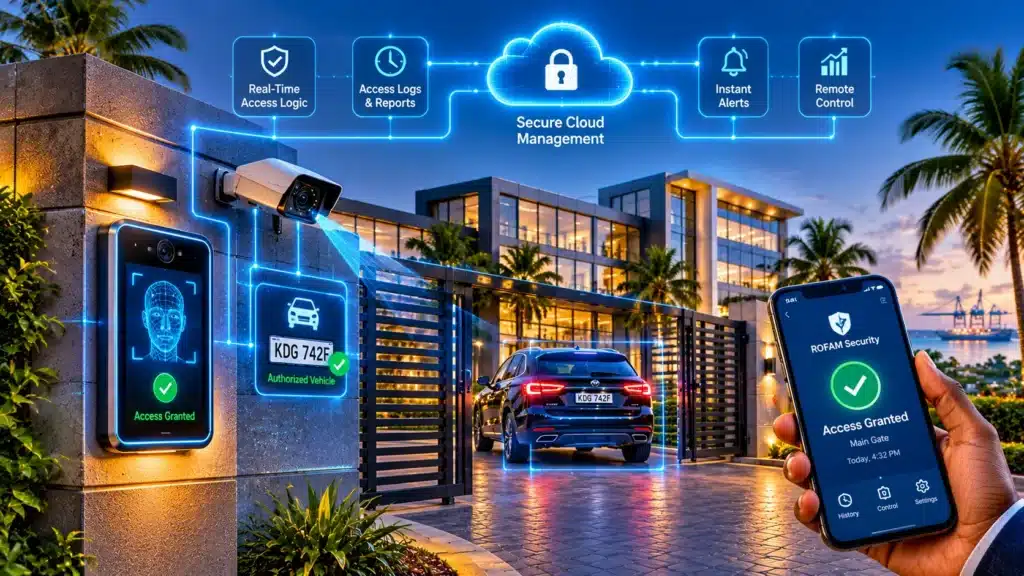
It’s a small shift in language that reflects a much bigger shift in expectations. A smart entrance isn’t just a gate with a motor bolted on. It’s a coordinated system of hardware, software, and access logic working together to decide, in real time, who gets in, when, and how that decision gets recorded. Understanding what actually goes into that system — and why it matters for property owners in East Africa specifically — is the difference between buying “an automated gate” and investing in real, lasting security.
Automation Is the Starting Point, Not the Destination
For most of East Africa’s history of residential and commercial security, a gate has meant one thing: a barrier, a padlock, and a guard to open it. That model is changing fast. Across Nairobi, Nakuru, Mombasa, and the fast-growing estates in between, property owners are asking a new question — not “how strong is the gate?” but “how smart is the entrance?”
It’s a small shift in language that reflects a much bigger shift in expectations. A smart entrance isn’t just a gate with a motor bolted on. It’s a coordinated system of hardware, software, and access logic working together to decide, in real time, who gets in, when, and how that decision gets recorded. Understanding what actually goes into that system — and why it matters for property owners in East Africa specifically — is the difference between buying “an automated gate” and investing in real, lasting security.
The Access Control Layer: Who Gets In, and How
The most visible part of any smart entrance is the automation: a gate that slides or swings open smoothly, quietly, and without someone physically pushing it. That alone is a meaningful upgrade for gated communities, hotels
, and commercial properties where manual gates create bottlenecks, wear out fast, and depend entirely on whoever is on duty.
But automation by itself is just convenience. What makes an entrance genuinely “smart” is what sits behind that motor — the access control layer that governs who can trigger it.
This is where the real technology lives. Modern smart gates in Kenya typically combine several access methods, layered so that a property can match the level of control to the level of risk:
- Remote control access for simple, fast entry — ideal for staff and repeat visitors.
- RFID card or tag systems, which let estate managers issue and revoke access instantly, without ever touching the physical gate.
- Biometric verification (fingerprint or facial recognition), which removes the risk of shared, lost, or duplicated access codes entirely.
- Mobile app integration, allowing residents, guests, or estate managers to grant temporary access remotely — useful for deliveries, visitors, or staff shift changes.
Together, these methods do something a padlock never could: they create a record. Every entry and exit becomes data — who came in, when, and through which method. For estate managers, hotel security teams, and property developers, that visibility is often more valuable than the gate itself. It turns a physical barrier into a monitored access point.
Built for East African Conditions, Not Just East African Demand
Here’s where a lot of imported “smart gate” technology quietly fails: it wasn’t engineered for the environment it’s being sold into. Kenya’s climate, power reliability, and site conditions all place real demands on gate automation systems.
A genuinely smart entrance for this market needs to account for:
- Durability against heat, dust, and rain — premium materials that don’t warp, rust, or degrade under harsh weather over years of daily use.
- Power resilience, including solar-powered options with emergency manual release, so a grid outage never means a security gap.
- Anti-climb, tamper-resistant construction, because access control software is only as good as the physical barrier it’s attached to.
- Local assembly and support, which matters enormously when a motor fails or a card reader needs recalibrating — a system with no nearby technician is a system that eventually gets propped open.
This is the layer that separates a genuinely smart entrance from an imported gadget with smart branding. Technology that ignores local conditions doesn’t stay smart for long.
Why This Matters More in East Africa Right Now
Property access technology isn’t trending in Kenya by coincidence. Several forces are converging at once: rapid growth in gated estates and boutique hospitality developments, rising buyer expectations around prestige and security, and a general shift toward measurable, accountable security — not just visible security.
For gated communities and private villas, a smart entrance signals property value as much as it delivers protection. For boutique hotels and commercial properties, it signals professionalism and guest confidence — a controlled, monitored point of entry rather than a guard relying on memory and judgment alone. And for estate managers and homeowners’ associations, the audit trail a smart system creates is quickly becoming as important as the gate itself, particularly as insurers and investors start asking harder questions about how a property manages access.
In short: as East Africa’s property market matures, “smart” access is becoming less of a luxury feature and more of a baseline expectation for premium developments.
How ROFAM Approaches Smart Entrances
At ROFAM, our Smart Gate — the Smart Entrance system — is built around this exact idea: automation, access control, and durability engineered together, not bolted on separately. It combines smooth, low-noise sliding and swing operation with remote, RFID, biometric, and mobile app access control, anti-climb and tamper-resistant construction, and solar-ready power options with manual emergency release.
Just as importantly, it’s assembled locally in Kenya to premium standards — built for gated estates, boutique hotels, and commercial and residential properties that expect both prestige and performance from their entrance.
We believe security shouldn’t be something a property owner has to think about constantly — it should simply work, quietly, in the background, every day. That’s the principle behind TUJILINDE, our community security promise: protection that comes from strength, precision, and togetherness, not just hardware.
See It Before You Decide
The best way to understand what a smart entrance actually feels like in daily use is to see one in person. ROFAM invites property owners, estate managers, and developers to visit our warehouse and office in Nakuru to experience the Smart Gate prototype live, and to schedule a free site assessment and customized quotation for your property.